 +1-718-715-1551
 sales@onprintshop.com




It could be very frustrating to discover that key customers’ order delivery got delayed as your team missed responding to the design proof email.
Print companies have invested a lot in machines and production but have not paid much attention to streamlining communication with clients. As a result, in spite of having large teams, technology, and software, they struggle to get the design approved in time and end up frustrating both the customer and the team.
One major reason for delays is not having a centralized communication platform that records all the communication from emails, calls, walk-ins, and WhatsApp, which can also be used for reference in the future. This removes the dependency on a particular individual, so the design approval process can be completed in time, even if that team member is unavailable.
As order quantities are going down and the cost of material and substrate are increasing, it is important to streamline every stage of the pre-production process. In addition, not having a centralized process can increase the possibility of delay in the pre-production stages.
Research shows that 34% of customers never shop with a company again afte just one bad experience. Moreover expected order turnaround time for print products is two to three days. Therefore, any delays in the pre-production stage can increase the chance of not fulfilling the order within the production timeline leading to a bad customer experience and any chance of repeat sales.

Major Challenges in Delayed Order Delivery
There are two types of customers print provider deals with, and both of them have their different set of challenges –
- The client who has artwork ready
- The clients who hire a designer for artwork designing
The client who has Artwork Ready
In this scenario, the client shares the ready artwork, and the majority of times during the preflight stage, Printers find out that some major elements are missing from the artwork such as the artwork not matching the product size, low-quality image, missing fonts, etc. This ultimately prevents the order from going directly to the production stage, adding to unnecessary delays and causing printers to be under constant pressure as they have to deliver print orders within three days average.
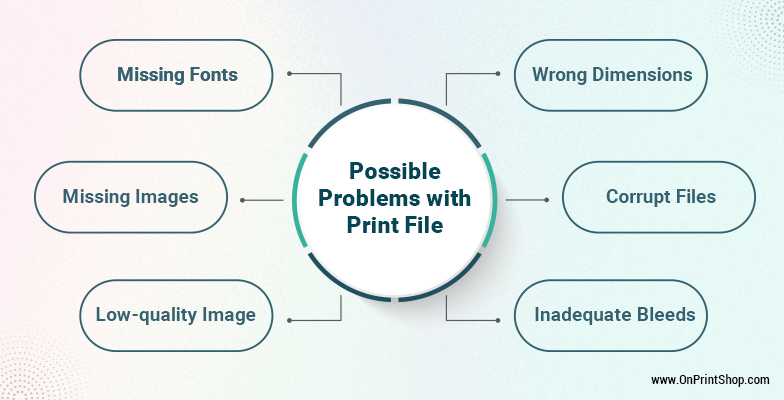
This process can be simplified and automated with Design Proofing Tool; Printer can set up minimum image quality and product size. The system will auto-check for the image quality and printable area and give a warning if anything is missing, then the customer will need to upload an updated file. This saves significant time in follow-up, and now the printer gets customer-approved files, which can be pushed directly into production
This has helped printers achieve a 80% Reduction in preparation time for print file.
The Clients who hire a designer for artwork designing
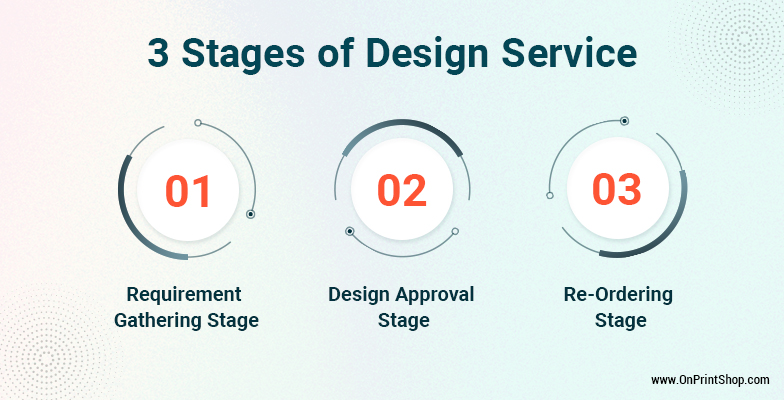
Print Provider who provides graphic design service to a client goes through three stages to fulfil
- Requirement Gathering Stage
- Design Approval Stage
- Re-ordering Stage
1. Requirement Gathering –
This is the most important stage as this helps the designer to understand what the client is looking for. This can be a never-ending stage and expensive if the designer does not follow a process or have a proper questionnaire to understand customers’ profiles and requirements.
The challenge starts when the designer creates an initial mock-up, and the customer rejects them as it is far from his expectations. Then, every time the client gives additional information, it goes into multiple iterations, as the designer needs to ask the right questions and record the details. Now, being frustrated when the customer escalates and requests a new designer, the same process of collecting information is repeated. Here, majority of the customers feel highly frustrated if they keep sharing the same information repeatedly.
It is essential to have a standard process and forms that can help collect all the information and keep track of the changes given by the customer at every stage.
To remove this hassle, many print companies delight their customers by offering the option of an online design library, which helps customers quickly select multiple options or pick up one of the designs and personalize it. This drastically reduces the cost and time spent in creating designs from scratch. The Print Companies have now partnered with designers to create a Designer Marketplace to offer unique designs and share the revenue with designers.
2. Design Approval –
The designer sends multiple options based on the requirement shared by the client. In the next step, the customer chooses one of the options and requests changes. This can be tricky and time-consuming if the customer needs to clearly explain changes in fonts, colours, designs, and placements. It could have multiple changes making it difficult for the designer to understand the changes. It could be nerve-breaking for either one to explain if both are not sitting next to each other.
Now, let’s assume that the designer understood the inputs. Still, the next challenge is if he misses making all the changes due to access to multiple emails or notes depending on the communication channel, as during the communication process, multiple communication channels are used depending on comfort. For example, sometimes the customer calls and shares the inputs, or they can send emails or ping you on WhatsApp.
The designer needs to ensure that he creates a common checklist from all the communications and keeps updating it after every single communication. This takes a lot of time, and it also increases the chances of errors. The customer gets upset as he has to keep repeating the same inputs and feels why cannot the designer be responsible and complete everything in one go.
The need is to have a Design Approval Tool that simplifies and manages all the communications and helps maintain versions for both designer and client to speed up sharing inputs and making changes.
3. Re-ordering –
In this stage, the challenge arises when the same customer wants to re-order the previous design as it is or with some changes.
But the question is how easy it is to find the design that was created weeks, months, or years back and if you have maintained a copy of the design. If the Print companies don’t find the design, they end up recreating the same file they designed and spending time and money.
This challenge can be solved using an Online Order Management solution that records customer data from giving estimation to order history and managing customers’ previous designs. In addition, helps to convert all offline into online editable designs, which can be easily editable by end customers or internal teams without the need for designers. This has helped Companies reduce from 6 people needed in order management to 2 people, helped increased repeat sales by 25% by simplifying re-ordering and saving multiple man hours which you have already invested initially to process the order. Most important increases client retention and sales as it makes life easy to manage his printing needs and digital assets from anywhere, anytime.
Final Thoughts
Today, every growing company invests in retaining customers, continuously evaluating their processes, and optimizing to deliver excellent post-purchase experience.
We have helped 100s of print companies to optimize the print approval process and simplify re-ordering as our team understands the technology and print processes.
Contact our team of experts if you want to automate your Print Order Processing.